
Finding a career that truly fits isn't just about matching your degree to a job listing. Many people spend years in work that pays well but feels hollow — productive on paper, draining in practice. Birth chart analysis offers a different lens: one that starts with who you are, not what the market demands.
Your natal chart is a snapshot of the sky at the exact moment you were born. Astrologers interpret it as a personality and potential map — not a fate, but a set of natural tendencies and strengths that can inform everything from how you communicate under pressure to what kind of environment lets you do your best work.
What Is a Birth Chart?
A birth chart — also called a natal chart — is a circular diagram mapping the exact position of the Sun, Moon, and planets at the time and place you were born. It is divided into 12 sections called houses, each governing a different life domain: identity, money, communication, home, career, relationships, and so on.
To generate an accurate chart, you need three things: your date of birth, your exact birth time, and your place of birth. The birth time is especially important — it determines which sign was rising on the eastern horizon (your Ascendant) and therefore which sign falls in each house, including the career-focused 10th house.
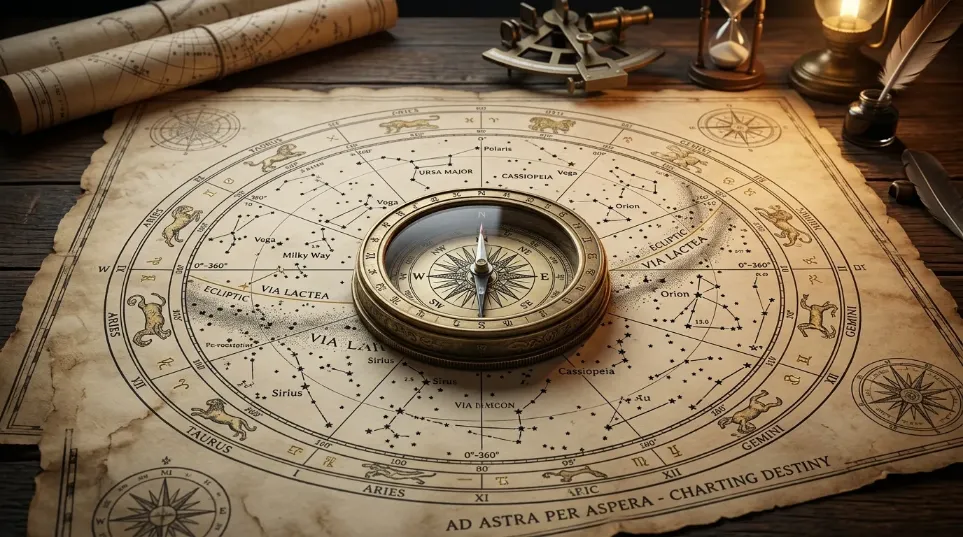
Astrology is a symbolic and interpretive practice, not a scientifically proven system. It works best as a tool for self-reflection alongside practical career planning — not as a replacement for skills development, experience, or professional guidance.
Why People Use Astrology for Career Guidance
Traditional career assessments like personality tests or aptitude scores focus on measurable traits. Birth chart analysis takes a wider view — it attempts to capture the emotional, motivational, and relational layers that standardized tests tend to miss.
People who turn to their natal chart for career insight are often looking to understand their natural working style, why certain environments energize them while others drain them, or why they feel pulled toward an unconventional path their résumé can't easily explain. The chart doesn't always tell you what job title to chase — it's more useful for identifying the underlying themes your most satisfying work tends to share.
Find Your Moon Sign Free
Your Moon sign reveals your emotional needs at work. Use our calculator — just enter your birth date, time, and location.
Key Placements That Reveal Career Potential
Not every planet in your chart carries equal weight for career. These six placements are the ones astrologers return to most consistently when mapping professional potential.
1. The Midheaven (MC) — Your Career Direction
The Midheaven — abbreviated MC from the Latin Medium Coeli — sits at the very top of your chart and is considered the single strongest indicator of career calling and public reputation. It represents your highest ambitions, the professional image you project to the world, and the type of contribution you most want to be remembered for.
Unlike your Sun or Moon sign, the Midheaven shifts sign every two hours, which is why an accurate birth time matters so much for career analysis.
2. The 10th House — Career and Public Reputation
The Midheaven sits on the cusp of the 10th house, which governs your profession, social status, and achievements. Planets located inside the 10th house add nuance — sometimes dramatically shifting the career themes the Midheaven alone would suggest.
- Sun in the 10th House — A drive to lead; career as a core part of identity
- Mercury in the 10th House — Writing, teaching, communication, media
- Venus in the 10th House — Design, beauty, hospitality, diplomacy
- Mars in the 10th House — Competitive careers, business, sports, advocacy
- Saturn in the 10th House — Long-term institution building, law, administration

3. Your Sun Sign — Core Identity and Life Purpose
Your Sun sign is the placement most people know from their birthday. In career terms, it reflects your core motivations — the type of work that lets you express your truest self rather than just perform a role. While it's far from the whole story, ignoring it entirely means ignoring the engine behind your ambition.
- Taurus — Finance, luxury goods, real estate, food
- Gemini — Journalism, sales, marketing, education
- Cancer — Caregiving, psychology, hospitality, family services
- Scorpio — Investigation, medicine, research, psychology
- Capricorn — Management, law, government, long-term projects
4. Your Moon Sign — Emotional Satisfaction at Work
This is one of the most overlooked career placements. Your Moon sign reveals what you need emotionally to feel fulfilled — and emotional fulfillment at work is a major predictor of long-term career satisfaction. You can be highly skilled in a field and still feel persistently drained if your Moon's needs go unmet day after day.
- Moon in Pisces — Creative, spiritual, or helping-oriented work
- Moon in Virgo — Organized, detail-focused, analytical roles
- Moon in Sagittarius — Travel, teaching, philosophy, exploration
- Moon in Libra — Collaborative, artistic, client-facing work
- Moon in Capricorn — Structure, achievement, measurable progress
5. Mercury — Your Communication and Thinking Style
Mercury governs how you process information, communicate ideas, and solve problems. In career terms, it shapes whether you thrive writing reports or leading brainstorming sessions, whether you're detail-oriented or big-picture, whether you prefer data or storytelling.
- Mercury in Gemini — Media, social media, PR, sales
- Mercury in Capricorn — Business strategy, finance, structured analysis
- Mercury in Aquarius — Technology, innovation, systems thinking
- Mercury in Pisces — Creative writing, music, counseling, storytelling
6. Mars — Drive, Ambition, and Work Style
Mars shows how you pursue goals. It's the planet of effort, competition, and initiative. Understanding your Mars placement can help you identify what kind of work environment brings out your best performance — and which ones make you restless or burned out.
- Mars in Aries — Fast-paced leadership, independent projects
- Mars in Virgo — Precision work, quality control, systematic output
- Mars in Libra — Negotiation, partnership, creative collaboration
- Mars in Scorpio — Deep research, investigative work, strategic roles
Career Themes by Zodiac Element
A useful shortcut for career analysis is looking at which element dominates your chart. If most of your major placements fall in fire signs, your career needs to involve leadership, visibility, and momentum. If they're mostly in earth signs, security and tangible outcomes matter most to you.
Fire Signs
Aries · Leo ·
Sagittarius
- Entrepreneurship
- Sports & competition
- Public speaking
- Entertainment & media
Earth Signs
Taurus ·
Virgo · Capricorn
- Finance & accounting
- Engineering
- Architecture & design
- Project management
Air Signs
Gemini ·
Libra · Aquarius
- Marketing & communication
- Technology & UX
- Journalism
- Teaching & research
Water Signs
Cancer ·
Scorpio · Pisces
- Counseling & therapy
- Art & creative fields
- Healthcare
- Psychology & research
How to Practically Apply Your Chart to Career Planning

Knowing your placements is the first step. Translating them into action is where most people stall. Here's how to use your chart practically:
Look for Repeating Themes
If your Midheaven, Mercury, and Moon all point toward communication and connection, that's a strong signal — not a coincidence. Look for overlap across multiple placements before drawing conclusions. One placement pointing toward medicine doesn't mean you're destined for a clinical role; three placements all pointing that direction is worth taking seriously.
Combine Astrology with Skills Inventory
Astrology highlights tendencies, not abilities. A Gemini MC points toward communication careers, but it doesn't make you a good writer — practice does that. Use your chart to identify which skills to prioritize developing, then build those skills deliberately.
Don't Let It Limit You
Charts can be used to expand possibilities or to shut them down, depending on how rigidly you interpret them. If your chart shows earth-heavy placements but you feel drawn to creative work, the chart isn't wrong — it might just be showing you the structure your creative work will need to sustain you financially.
Revisit the Chart at Career Crossroads
Many people find their birth chart most useful not when they're starting out, but when they're stuck — when they've built something that looks successful on the outside but feels wrong on the inside. At those moments, going back to core chart themes can help you identify what the current role is missing.
What's Your Birth Sign?
Not sure which zodiac sign you are? Our birth sign calculator tells you instantly — just enter your date of birth.
What Astrology Cannot Tell You
A birth chart can point toward themes, environments, and working styles that tend to fit you. It cannot measure your discipline, the quality of your education, your professional network, or the economic conditions in your industry at any given time. Career success depends on all of these — and none of them appear in a natal chart.
Think of it this way: a chart showing Aries Midheaven doesn't guarantee entrepreneurial success any more than a Leo Midheaven guarantees fame. What it might tell you is that a rigid, hierarchical environment will chafe against your natural tendencies — useful self-knowledge to have, but far from a complete career plan.