
Ask someone how old they are and they'll answer in years — probably without a second thought. But that single number hides something much more interesting. Underneath it is an exact count of years, months, and days. A total number of days you've been alive. A specific day of the week you arrived in the world. And a handful of numerical milestones buried in your timeline that almost nobody knows about.
This article explains how exact age calculation actually works, what your age looks like in days and hours, how to find out what day of the week you were born, and why the 10,000-day birthday deserves more attention than it gets.
The Surprising Math Behind "How Old Am I Exactly?"
Calculating age to the year is easy. Calculating it exactly to the day — in years, months, and days — is trickier than most people expect. The problem is that months don't have the same number of days.
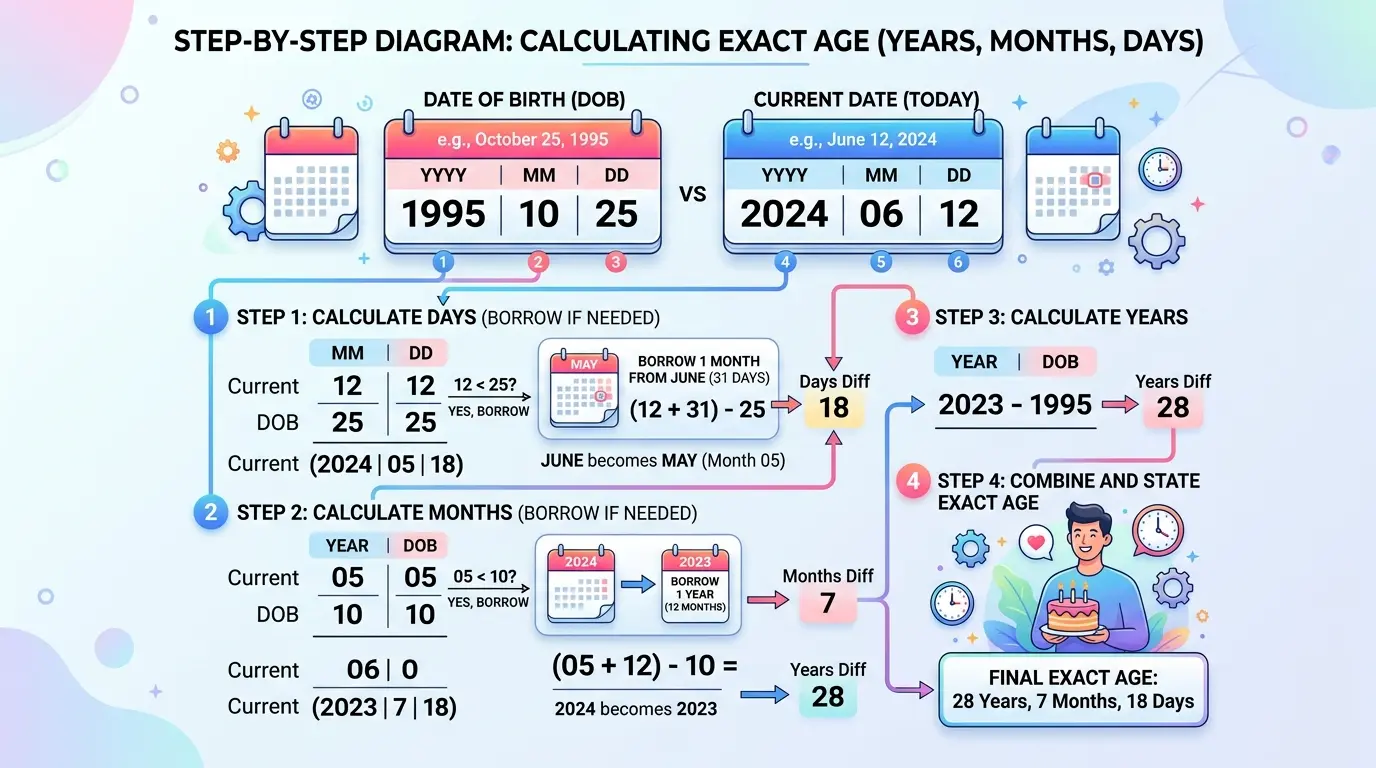
Here's the algorithm that gives you the right answer every time:
- Start with the full years. Subtract your birth year from the current year. Then check whether today's month and day have passed your birthday month and day in the current year. If not, subtract one — you haven't had your birthday yet this year.
- Count the remaining months. From your birth month forward to the current month. If today's day-of-month is earlier than your birth day-of-month, subtract one month and carry the days to step 3.
- Count the remaining days. Using the actual length of the previous month — 28, 29, 30, or 31 days, depending on which month and whether it's a leap year.
That last step is where manual calculation breaks down. February changes length every four years. This means the number of "days remaining" between two months shifts depending on when you're counting. A person born on January 31 who is counting their age on March 1 gets a different result than someone born on January 1 — because January has 31 days, which affects how the day remainder carries over.
How Many Days Old Are You? The Number That Always Surprises People
When people first see their age in total days, the reaction is almost always the same: "That's way more than I expected." A 30-year-old isn't 10,000 days old yet — they're closer to 10,950. A 25-year-old has lived around 9,125 days. These numbers feel large because we don't naturally think about life in those units.
To calculate your total days alive:
- Count every calendar day from your date of birth to today
- Each leap year adds one extra day to your total
- There's no shortcut formula — the count depends on exactly which years (and which months) fall in your lifespan
For a rough estimate: multiply your age in years by 365, then add roughly one day for every 4 years (for leap years). A 32-year-old gets: 32 × 365 = 11,680 + 8 = approximately 11,688 days. The exact number will differ by a few days depending on your specific birthdate.
Converting Days to Hours and Minutes
The numbers get even more interesting when you go further. Take your total days and multiply by 24 to get approximate hours alive. Multiply by 1,440 for minutes. A 30-year-old has lived roughly 262,800 hours — or over 15.7 million minutes. Numbers at this scale shift how you perceive time in a useful way.
What Day of the Week Were You Born? How to Find Out
The day of the week you were born is genuinely hard to figure out without a tool. Most people have no idea whether they arrived on a Monday or a Saturday — and there's no simple way to work it out in your head.
The calculation uses a mathematical algorithm (Zeller's congruence or the Tomohiko Sakamoto method) that converts any Gregorian calendar date into a day-of-week index. The result is accurate for any date from October 15, 1582 onward — the first day of the Gregorian calendar.
Enter your date of birth in the CalcMeter Age Calculator and the result panel shows your birth day immediately — no mental gymnastics required.
What Your Birth Day Supposedly Means
The old English nursery rhyme "Monday's Child" assigned personality traits to birth days — "Monday's child is fair of face, Tuesday's child is full of grace" — and while there's no scientific basis for it, it's the kind of thing people find surprisingly interesting once they know their birth day. Below is a quick reference:
| Day Born | Traditional Trait (Nursery Rhyme) | Notable People Born on This Day |
|---|---|---|
| Monday | Fair of face | JFK, Adele, Neil Armstrong |
| Tuesday | Full of grace | Elvis Presley, Marie Curie |
| Wednesday | Full of woe | Barack Obama, Taylor Swift |
| Thursday | Has far to go | Abraham Lincoln, Albert Einstein |
| Friday | Loving and giving | Freddie Mercury, Michael Jackson |
| Saturday | Works hard for a living | Elon Musk, Isaac Newton |
| Sunday | Bonny and blithe | Winston Churchill, Oprah Winfrey |
Birth day associations are cultural folklore, not science. The notable people listed are examples only.
How Old Will I Be in 2030? Calculating Age on Any Future Date
One of the most practically useful things an age calculator can do is answer future-age questions. "How old will I be when I retire?" "Will I be 18 before the election?" "How old was my grandfather when I was born?" All of these are future or past date questions — not just "how old am I today."
The math for future age is straightforward: subtract your birth year from the target year, then check whether your birthday has passed by the target date. If you were born on October 15, 1995:
- On January 1, 2030: you're 34 years old (your birthday hasn't happened yet in 2030 at that point)
- On October 15, 2030: you turn exactly 35
- On December 31, 2030: you're still 35
The CalcMeter Age Calculator handles this automatically with the "Calculate age on" field — set it to any past or future date and it returns your exact age for that day.
Common Reasons People Calculate Future Age
- Retirement planning — "I want to retire at 65. What year is that?"
- Legal age milestones — driving at 16, voting at 18, drinking at 21, running for president at 35
- Social Security eligibility — full retirement benefits begin at 67 for most Americans born after 1960
- How old was someone at a historical event — "How old was Neil Armstrong when he walked on the moon?" (He was 38)
- Baby development tracking — pediatricians use exact age in weeks and months for the first two years
The 10,000-Day Birthday and Other Age Milestones Worth Knowing
Your birthday happens once a year. But buried in the calendar are other numerical milestones based on your total days alive — and they tend to sneak up on people completely unnoticed.
The most talked-about one is the 10,000-day birthday. It falls at approximately 27 years, 4 months, and 13 days old — which means most people hit it in their late twenties without ever realizing it. When people discover theirs and share it, the reaction is almost universally "wait, that already happened?" or "mine is only three months away!"
Use the Age Calculator to find your next upcoming milestone and the exact date it falls on. The milestone panel in the results automatically shows you the nearest one.
Why Day-Based Milestones Feel Meaningful
Part of what makes the 10,000-day milestone resonate is that it's not arbitrary in the way that, say, a 30th birthday can feel. Thirty years is culturally significant — but it's a round number we invented. Ten thousand days is a clean, satisfying number that lands at an unexpected age, which makes it feel discovered rather than assigned. It also reframes how you think about time — not as years ticking past, but as days accumulating into something specific and countable.

6 Practical Situations Where Knowing Your Exact Age Matters
Beyond curiosity, there are real-world contexts where knowing your exact age — especially to the month or day — is genuinely important.
1. Legal Age Verification
Driving, voting, drinking, and many other rights are age-gated to the exact day. If your birthday is tomorrow and you're at a polling station today, you're not yet eligible — even if you turn 18 at midnight. Knowing your exact birthday relative to an event matters in these cases.
2. Retirement and Social Security Planning
Social Security in the US calculates eligibility by exact birth month and year. Claiming at 62 versus 67 versus 70 produces meaningfully different monthly payments. Knowing exactly when you'll reach the relevant thresholds — not just the year, but the month — helps with accurate planning.
3. Medical and Pediatric Forms
Doctors — especially pediatricians — assess children by exact age in weeks and months, not just years. "My child is 2" is far less useful to a physician than "my child is 26 months and 2 weeks." Developmental milestones are calibrated to specific windows, and knowing the exact age helps flag when something may be off-schedule.
4. Age-Restricted Financial Products
IRAs, 401(k)s, and other retirement accounts have rules tied to exact ages. Required Minimum Distributions (RMDs) begin at age 73 under current IRS rules. Early withdrawal penalties lift at 59½ — not 59 years, 6 complete months. The distinction between 59 years and 5 months vs. 59 years and 6 months can cost thousands of dollars in penalties.
5. Insurance Underwriting
Life insurance and health insurance premiums are often recalculated at your "insurance age" — which many policies define as the birthday you're nearest to, not your most recent birthday. If you're 42 years and 7 months old, your insurance company may already be pricing you as a 43-year-old. Knowing your exact age relative to this threshold can affect when it's worth locking in a policy.
6. Genealogy and Family History Research
When researching family history, census records and vital statistics often include only birth years, not full dates. Cross-referencing ages at specific events — "my great-grandfather was 34 in the 1910 census" — lets you triangulate approximate birth years and verify records. Exact age calculation works backwards too.
Frequently Asked Questions
The Bottom Line
Your age in years is a coarse summary of something much more specific. Behind it is an exact count of years, months, and days — a precise number of days you've been alive, a specific day of the week you were born, and a handful of numerical milestones you've either already passed or are quietly approaching.
None of this changes anything practical. But knowing the details of your own existence — that you've been alive for 11,432 days, that you were born on a Thursday, that your 10,000-day birthday was three years ago or is coming up in four months — has a way of making time feel concrete rather than abstract.
Use the CalcMeter Age Calculator to find yours. The milestone panel will show you what's coming next.