Islamic Finance

Zakat Calculator

Calculate your annual Zakat obligation accurately. Covers all asset categories — cash, gold, silver, investments, business assets — with real-time nisab comparison.

📐 Both nisab thresholds calculated automatically
📐
Precious Metal Prices
Enter current market prices per gram in your currency
💵

Cash & Liquid Assets

Physical cash, bank accounts, deposits, foreign currency

Section total
🪙

Gold & Silver

Physical gold, silver, jewelry (Hanafi: include all)

Section total (at market value)
📈

Investments & Savings

Stocks, bonds, provident fund, insurance principal

★ Insurance is impermissible in Islam, but if collected, Zakat is due on the principal amount.

Section total
🏢

Business Assets

Inventory, raw materials, cash in business, receivables

Section total
🏠

Property & Real Estate

Investment properties only — NOT your primary residence

Section total
🚗

Vehicles & Other Assets

Only vehicles held for resale or business — not personal use

Section total
💳

Financial Liabilities & Debts

Loans, unpaid bills, rent due, salaries payable

⚠️ Only deduct liabilities that are currently due. Long-term mortgages on your primary home are generally not deductible.
Total deductions

Zakat Summary

Updates in real time as you enter values

Total assets
Total liabilities
Net zakatable wealth
🥇 Gold nisab (85g)
🥈 Silver nisab (595g)
0 Silver Nisab
Zakat Due
Enter values above to calculate
2.5% of net zakatable wealth (i.e. Net ÷ 40) · Using silver nisab (lower & more conservative)

What is Zakat — Islamic pillar of wealth purification

What is Zakat? The Third Pillar of Islam

Zakat (زكاة) is one of the Five Pillars of Islam and one of the most important acts of worship in the Islamic faith. It is a mandatory form of almsgiving — an annual purification of wealth — that every financially capable Muslim must pay to support those in need. Unlike voluntary charity (Sadaqah), Zakat is an obligation with precise rules on how it is calculated, who must pay it, and who is eligible to receive it.

The word Zakat comes from the Arabic root meaning "to purify" or "to grow." By paying Zakat, a Muslim purifies their remaining wealth and fulfills a communal responsibility to reduce poverty and economic inequality within the Muslim community.

📖 The Quran mentions Zakat alongside Salah (prayer) over 80 times — emphasizing its equal importance among the pillars of faith.

Zakat is due at a rate of 2.5% on all net zakatable wealth that has remained above the Nisab threshold for one full lunar year (known as Hawl). The eight categories of eligible recipients are specified in Surah At-Tawbah (9:60): the poor, the needy, Zakat collectors, new Muslims, those in debt, travelers in need, those striving in Allah's cause, and freeing of captives.

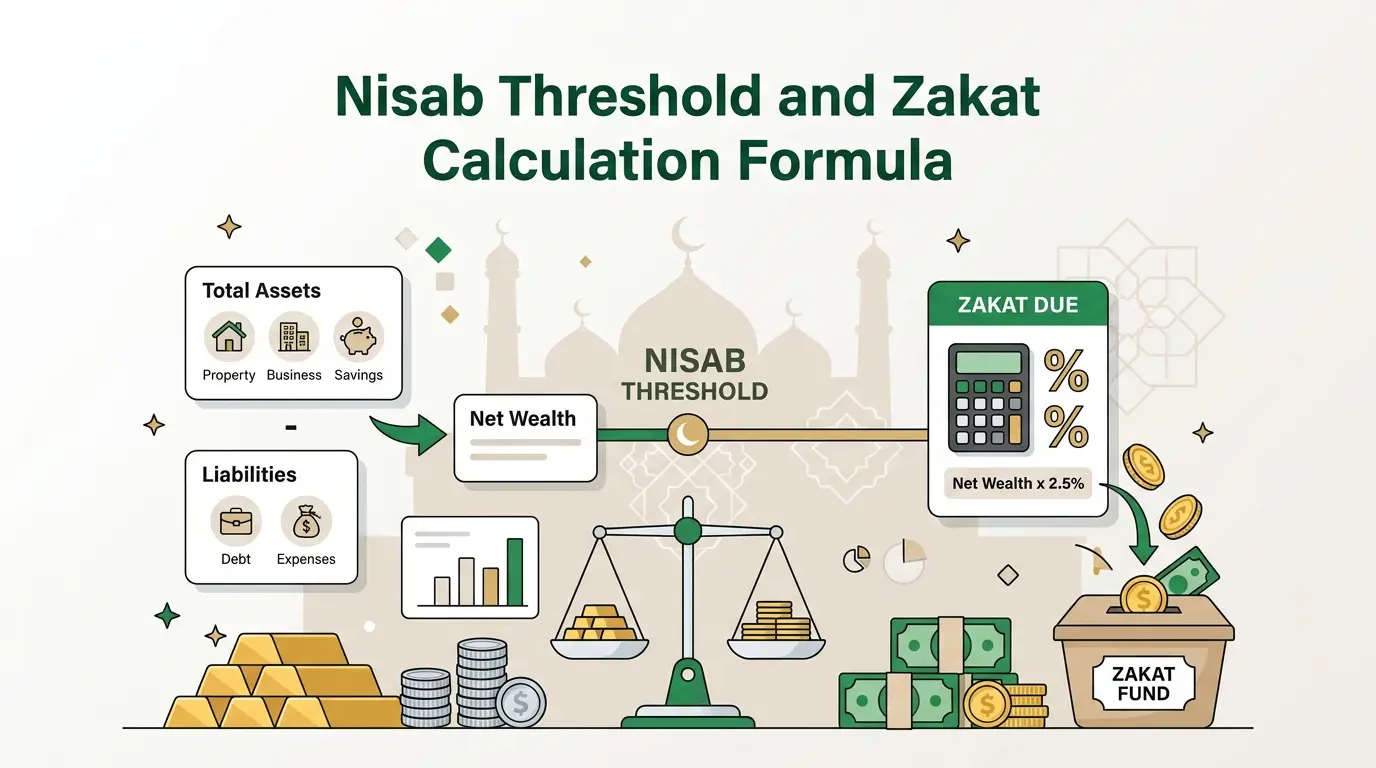
Nisab threshold and Zakat calculation formula

How is Zakat Calculated? Nisab, Hawl & the 2.5% Rule

Calculating Zakat involves three core concepts: the Nisab (minimum threshold), the Hawl (one lunar year holding period), and the Zakat rate of 2.5%.

  • Nisab (Gold basis): 85 grams of gold. If the gold price is $95/gram, the gold nisab is $8,075.
  • Nisab (Silver basis): 595 grams of silver. At $1.00/gram, the silver nisab is $595 — significantly lower.
  • Hawl: Your net wealth must stay above the Nisab for a full Islamic lunar year (354 days) before Zakat becomes due.
  • Zakat Formula: Zakat = 2.5% × (Total Zakatable Assets − Short-term Liabilities)

Many scholars recommend using the silver nisab as it is more inclusive and ensures more Muslims fulfill their obligation. Others use the gold nisab. Both are valid — select the basis you follow in the calculator above.

🧮 Example: If your net wealth is $20,000, your Zakat = 2.5% × $20,000 = $500
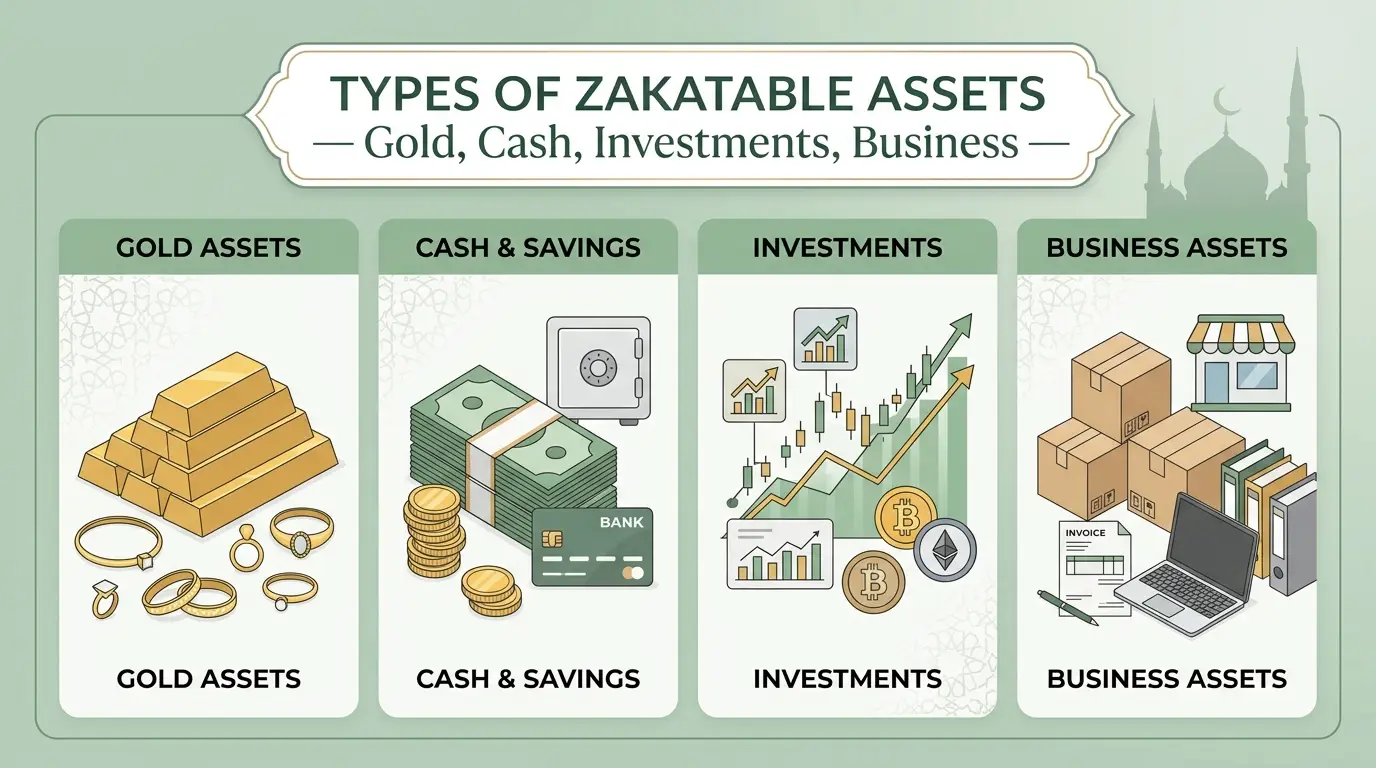
Types of zakatable assets — gold, cash, investments, business

Which Assets Are Subject to Zakat?

Not all wealth is zakatable. Islam distinguishes between assets that are "growing" (productive/tradable) and personal necessities. Here's a quick guide to what counts toward your Zakat calculation:

  • Cash & bank balances — fully zakatable, including foreign currency
  • Gold & silver — zakatable at market value (Hanafi: includes all jewelry)
  • Stocks & shares — zakatable on current market value or zakatable portion
  • Cryptocurrency — zakatable at current market value (digital trading assets)
  • Business inventory & receivables — zakatable at current value
  • Investment properties — zakatable if held for resale or producing rental income
  • Primary residence — not zakatable (personal necessity)
  • Personal vehicles — not zakatable if used for personal transportation
  • Household furniture & appliances — not zakatable

When in doubt, consult a qualified Islamic scholar for assets in grey areas, such as pension funds, EOBI contributions, or shares in companies with mixed halal/haram income.

When and where to pay Zakat — Ramadan, nisab, eligible recipients

When to Pay Zakat & Who Receives It

Zakat becomes due once your wealth has exceeded the Nisab threshold for one complete lunar year (Hawl). While it can be paid at any point during the year once the Hawl is complete, many Muslims choose to pay during Ramadan for the additional spiritual reward. Some even pay in advance, which is permissible if the Nisab has already been met.

The eight categories of eligible Zakat recipients, as defined in the Quran (9:60), are:

  • Al-Fuqara — The poor who cannot meet basic needs
  • Al-Masakin — The needy who are in financial hardship
  • Al-Amileen — Zakat administrators and collectors
  • Al-Mu'allafah — New Muslims or those whose hearts are to be reconciled
  • Ar-Riqab — Freeing of enslaved people (historically)
  • Al-Gharimeen — Those in debt they cannot repay
  • Fi Sabilillah — Those striving in the cause of Allah
  • Ibnus-Sabil — Travelers in need who are far from home
🕌 You can pay Zakat directly to individuals in need, or through verified Islamic charity organizations such as Edhi Foundation, Akhuwat, or Saylani Welfare Trust in Pakistan.

Frequently Asked Questions about Zakat

Authentic answers to common questions about Zakat calculation

What is the Nisab threshold for Zakat in 2025?
The Nisab is the minimum amount of wealth a Muslim must hold before Zakat becomes obligatory. It is equivalent to 85 grams of gold (gold nisab) or 595 grams of silver (silver nisab). Because silver prices are generally lower, the silver-based nisab results in a lower threshold and is used by many scholars as the more conservative (inclusive) standard. You can set your preferred basis in the calculator above and enter current market prices to get an accurate nisab figure.
Is Zakat 2.5% of total assets or net wealth?
Zakat is 2.5% of your net zakatable wealth — meaning your total eligible assets minus your short-term liabilities. Short-term debts (those due within the current year), credit card balances, and pending bills can be deducted. Long-term mortgages on your primary residence are generally not deductible. This net figure, if above the Nisab, is the basis of your Zakat calculation.
Do I pay Zakat on my primary home?
No. Your primary residence (the home you live in) is not subject to Zakat because it is a personal necessity, not a productive or tradable asset. However, investment properties held for rental income or resale are zakatable. The value of such investment properties — or the rental income received and saved — should be included in your Zakat calculation.
Is Zakat due on stocks and cryptocurrency?
Yes. Stocks and cryptocurrency are generally subject to Zakat because they are tradable assets held as investments. For stocks, many contemporary scholars recommend calculating Zakat on the current market value of your shares. For cryptocurrency (Bitcoin, Ethereum, etc.), Zakat is calculated on the current market value at the time of your Zakat calculation date. Some scholars advise a more nuanced approach for stocks — deducting only the zakatable portion of a company's underlying assets — but using market value is the most common practical approach.
When should Zakat be paid?
Zakat becomes due once your wealth has remained above the Nisab threshold for a full Islamic lunar year (Hawl — approximately 354 days). Many Muslims set a personal Zakat anniversary date and calculate it annually on that date. While Ramadan is the most popular time to pay (for additional spiritual reward), Zakat can be paid at any time once the Hawl is complete. Paying in advance before the Hawl completes is also permissible.
Is Zakat payable on gold jewelry worn daily?
Scholars differ on this point. The Hanafi school (widely followed in Pakistan, India, and Turkey) holds that all gold and silver jewelry is zakatable, regardless of whether it is worn. The Maliki, Shafi'i, and Hanbali schools generally exempt jewelry that is actually worn for personal use, provided it does not exceed a reasonable amount. Our calculator includes a gold input field — enter your gold jewelry if you follow the Hanafi position, or enter only investment/excess gold if you follow another madhab.

Explore More CalcMeter Tools